Эта статья на русском: читать по-русски
For thirty years, the prescription for fixing a procurement function has remained remarkably consistent. Centralize spend. Implement category management. Add a P2P system. Digitize the tail. Hire a CPO with a big title and a mandate to cut costs.
It hasn't changed much — because the underlying organizational model hasn't changed at all. Procurement is still a function inside a hierarchy, reporting upward, accountable for savings, measured on Purchase Price Variance.
The most interesting challenge to this model isn't coming from AI or from consulting frameworks. It's coming from Asia Pacific — and it's organizational.
Zhang Ruimin and the end of the middle manager
In 2012, Zhang Ruimin — the founder and then-CEO of Haier — did something that management theorists still debate a decade later. He began dismantling his own organization.
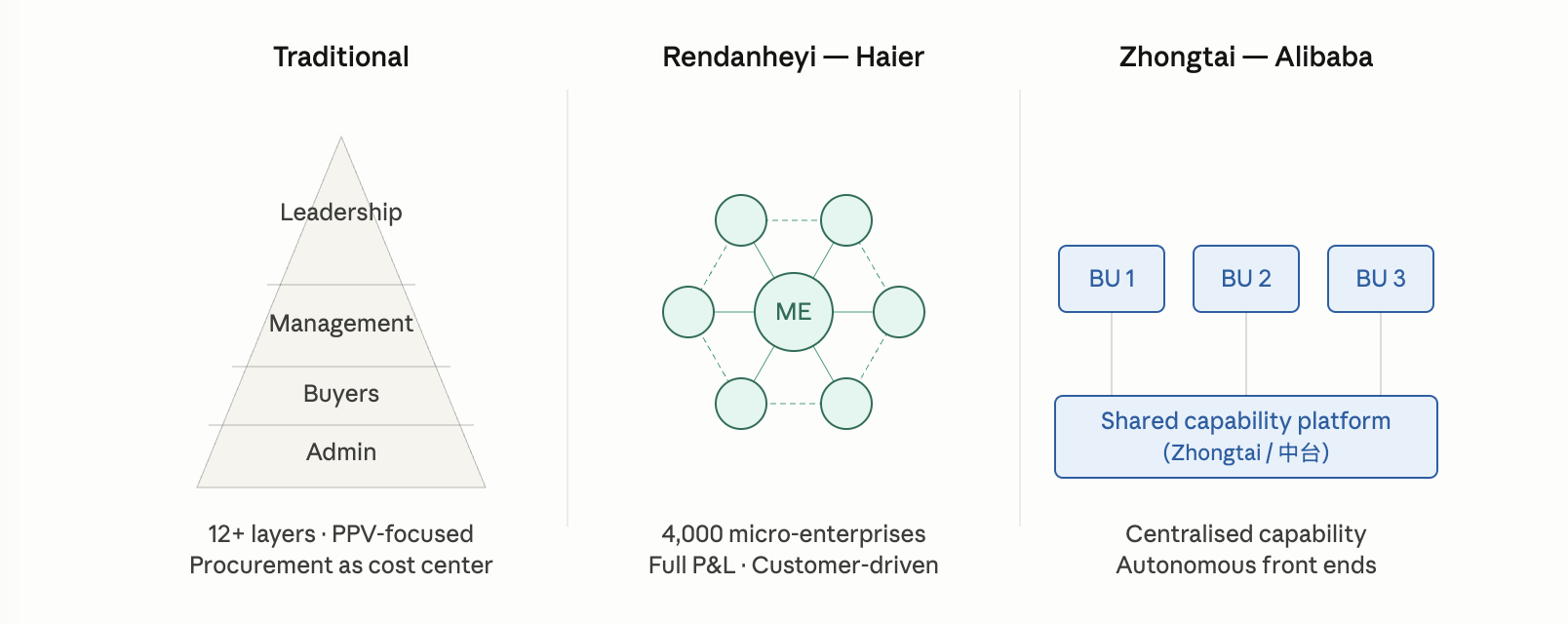
Haier, then a $20B appliance manufacturer with 80,000 employees, was reorganized into approximately 4,000 micro-enterprises. Each unit operates as an independent business with its own P&L, its own market positioning, and the authority to hire, partner externally, and set its own strategy. Middle management — twelve layers of it — was reduced to three. Decision-making speed improved by 67%. Over the following decade, Haier delivered 28% annual growth, profit growth of 1,200%, and became the world's largest white goods company.
Zhang called the model Rendanheyi — a term constructed from three Chinese concepts: ren (employee), dan (user value), heyi (unity). The core idea: every person in the organization should be in direct connection with the value they create for customers. The hierarchy that sits between them is friction, not management.
The procurement implication is radical. In a Rendanheyi structure, procurement isn't a centralized function controlling spend on behalf of the business. It is itself a micro-enterprise — competing for internal clients, accountable for real value creation, and capable of partnering externally if its internal offering isn't competitive. Category managers stop being cost controllers inside a hierarchy. They become entrepreneurs with a P&L.
Alibaba's Middle Platform: a different APAC model
Haier's answer is radical decentralization. Alibaba arrived at a different solution — equally Asian in its logic, but structurally opposite.
In 2015, CEO Daniel Zhang formalized what became known as the Zhongtai model — the "middle platform." Instead of centralizing functions into a monolithic shared services organization, Alibaba built a layer of shared capabilities — data infrastructure, logistics intelligence, supplier networks, financial services — that multiple business units consume as a platform. Taobao, Tmall, Lazada, and dozens of other units operate as autonomous "front ends," moving fast and adapting to their markets. The middle platform handles complexity, scale, and continuity underneath them.
For procurement, the Zhongtai logic means: centralize the capability, not the decision. The platform holds supplier relationships, category intelligence, risk data, and contract infrastructure. Business units draw on it at market speed, without navigating a procurement hierarchy. The function becomes infrastructure, not a gatekeeper.
Two APAC models, two organizational philosophies — both of which outperform the Western default of centralized procurement with siloed category ownership.
Why these models emerge here: the cultural substrate
You cannot fully understand Rendanheyi or Zhongtai without understanding the cultural context that made them possible — and the deliberate way they work with or against it.
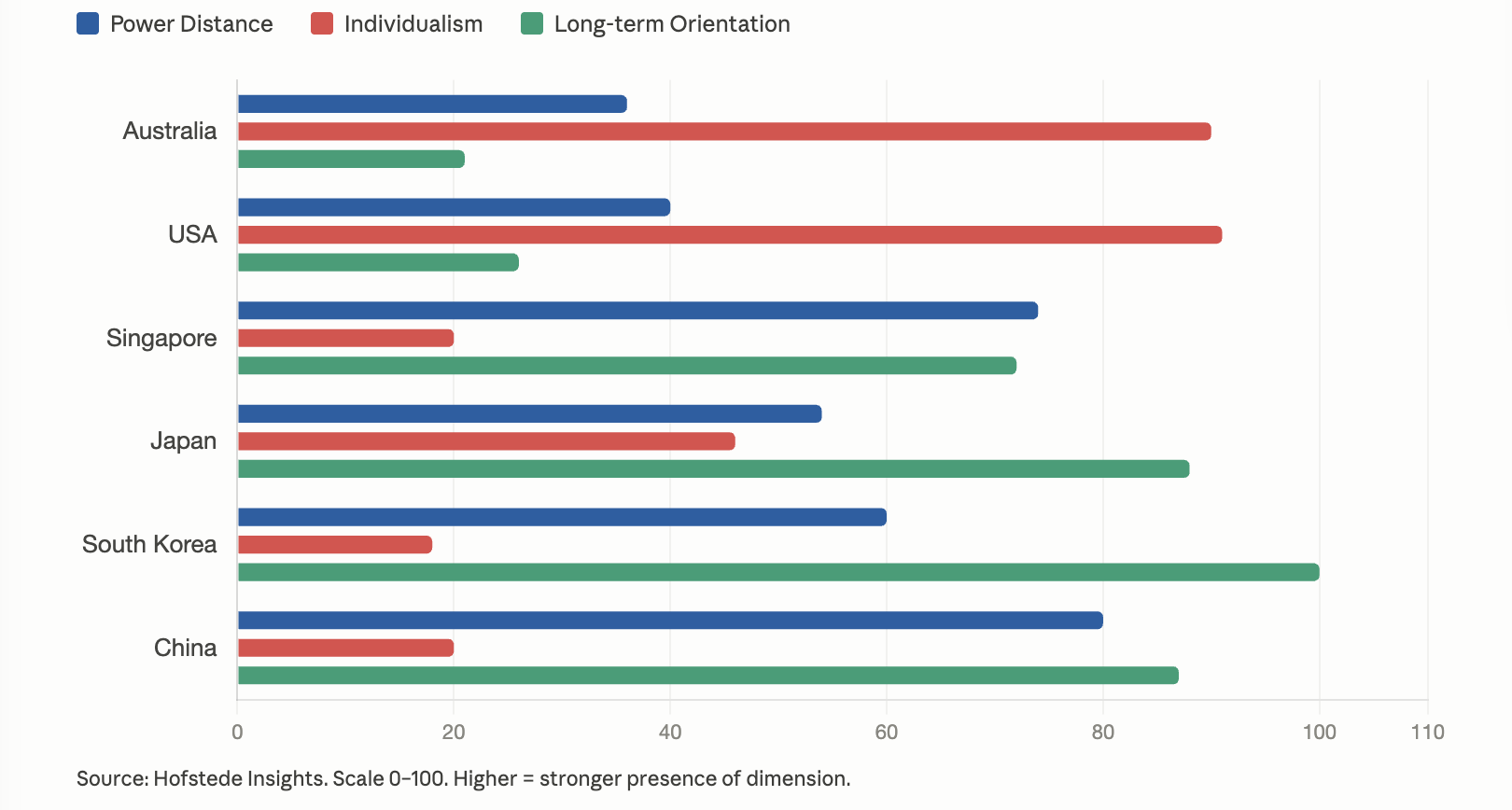
Geert Hofstede's research gives us a starting framework. East Asian cultures score extremely high on long-term orientation — China at 87, Japan at 88, South Korea at 100. This shapes how supplier relationships are built: not as transactional contracts to be renegotiated each cycle, but as long-term investments in shared capability. A supplier in Japan or Korea is not a vendor to be squeezed — it is a partner in whom you invest. The keiretsu model in Japan institutionalized this into ownership structures. Samsung and Hyundai built entire supplier ecosystems this way.
East Asian cultures are also deeply collectivist — China scores 20 on individualism, South Korea 18. Group accountability feels natural; individual P&L does not destabilize team cohesion. This is what enables Rendanheyi's micro-enterprise accountability model in ways that would be culturally difficult to sustain in Australia (individualism: 90) or the United States (91).
Erin Meyer adds a behavioral layer. Her trusting dimension is perhaps the most consequential for procurement: most of APAC operates on relationship-based trust — where trust must be built through personal connection, shared time, and investment before a contract is signed. A Chinese supplier who trusts you personally will solve your problem at 2am during a crisis. One who only has a signed SLA may not.
Her communicating dimension matters equally. High-context cultures — Japan, China, Korea, most of Southeast Asia — communicate meaning implicitly, through context and relationship rather than explicit statement. A procurement contract in Japan carries a different weight than the same document in Germany: it captures the skeleton of an agreement, not its full content. The living understanding exists in the relationship, not on paper.
The paradox at the center: Rendanheyi is a model born in China — one of the highest power distance countries on Hofstede's scale. Zhang Ruimin built it explicitly to counteract the Confucian hierarchy that would otherwise calcify his organization. It is not a product of Chinese culture — it is a deliberate intervention against one of its tendencies, made possible by another: the collectivist cohesion that allows small entrepreneurial teams to self-organize without the atomization that haunts Western decentralization experiments.
The cross-cultural procurement function
At Dodo Brands, the function is split along three clear lines: procurement, supply, and projects. Within procurement, global and regional teams are not hierarchically differentiated — they carry the same roles and the same mandate. What distinguishes them is category scope, not function. For dairy, packaging, and coffee — categories where consolidating volume across all markets creates meaningful scale — the approach is global: one team, only a couple regional cluster strategies, all geographies. For everything else, regions own the decision.
The cultural challenge this creates is not one of strategy versus execution. It is the same function, performing the same work, in markets that sit at very different positions on Meyer's map. A supplier negotiation run identically in Moscow and Dubai will produce different outcomes — not because the category strategy is wrong, but because trust, communication style, and hierarchy work differently in each context. Functional clarity around category ownership doesn't resolve that. It only makes the cultural gap more visible.
Quantifying the decision: when does global category management pay?
The choice between global and regional category scope is not intuitive — it is a calculable trade-off between scale savings and coordination costs, where cultural distance acts as the key moderating variable.
Define the net value of global category management:
NV_global = ΔS(n) − ΔC(n, D̄)
Where ΔS(n) is the incremental savings from consolidating spend across n markets, and ΔC(n, D̄) is the coordination cost — a function of market count n and their average cultural distance from the procurement center, D̄.
Scale savings follow a logarithmic curve — each additional market contributes less than the previous one:
ΔS(n) = α · V · ln(n / n₀)
Coordination costs scale linearly — more markets mean more alignment cycles, and greater cultural distance means each cycle consumes more time and relationship capital:
ΔC(n, D̄) = β · D̄ · n
Global category management is optimal when NV_global > 0. Rearranging gives the critical spend threshold V*:
V* = β · D̄ · n / (α · ln(n / n₀))
Categories above V*: global approach generates positive net value. Categories below V*: regional management is more efficient.
Cultural distance D̄ is measured using the Kogut-Singh index — the standard quantitative measure in international business research:
CD_hj = (1/4) · Σᵢ [(I_ij − I_ih)² / Vᵢ]
Where I_ij is country j's score on Hofstede dimension i, I_ih is the home market's score, and Vᵢ is the variance of that dimension across the full country sample. The index aggregates the cultural gap between two markets across all four Hofstede dimensions into a single number.
Populating with illustrative parameters: α = 0.03 (3% savings per doubling of consolidated spend), β = $15,000 per market per year in coordination overhead, n = 25 markets.
At moderate cultural diversity (D̄ = 1.5):
V* = 15,000 × 1.5 × 25 / (0.03 × ln 25) ≈ $5.8M
Categories with annual consolidated spend above ~$6M: global management creates net value. Below that threshold — regional wins on economics.
The cultural distance effect shifts this threshold systematically:
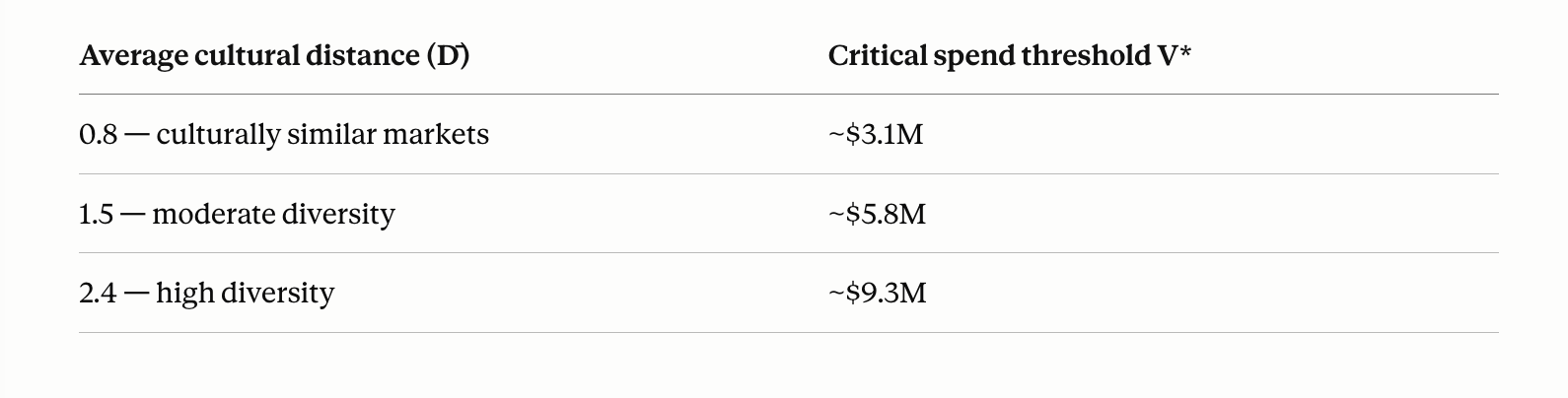
As market diversity increases, the volume bar for global category management rises significantly. Organizations with highly heterogeneous footprints need substantially larger category spend to justify consolidation — and they consistently over-centralize when they ignore this variable entirely.
The model also explains the reverse: why low-volume, locally differentiated categories resist global management not just culturally, but economically. The coordination drag outweighs the scale gain before you even account for execution quality. Regional teams, operating within their own cultural context, simply get more done per dollar of organizational effort.
This is what Hofstede quantifies and what Rendanheyi operationalises: cultural distance is not a soft management challenge. It is a cost variable with a precise effect on organizational efficiency — and procurement function design that ignores it will chronically misallocate decision rights.
What this means for how you design your function
The organizational revolution coming from APAC is not a set of models to copy. Rendanheyi transplanted into a Western organization without the cultural substrate would produce chaos. Zhongtai without Alibaba's data infrastructure would be a PowerPoint.
What APAC offers is a different set of questions:
What if procurement accountability lived at the level of the value it creates — not the level of the spend it manages? What if the function were infrastructure rather than control? What if the organizational model started from the culture of the people running it, not from a Western best-practice template?
And — perhaps most practically — what if you quantified the coordination cost of cultural distance before deciding which categories to manage globally?
The companies asking these questions most seriously — Haier, Alibaba, and the next generation of APAC operators building supply chains from scratch — are building procurement functions that look nothing like the ones in the textbooks.
That, more than any technology, is the revolution worth watching.
Originally published on .
