The procurement business process is the sequence of steps a company follows to turn an internal need into goods or services delivered, paid for and managed: from recognising the need and describing it, through choosing a supplier and signing a contract, to the purchase order, receipt, payment and supplier performance review.
I first wrote about this topic in 2013, starting with the very first stages. This is a complete rewrite: the whole process in nine steps, who owns each step, the documents involved, the KPIs that tell you whether it works, and the mistakes I see most often.
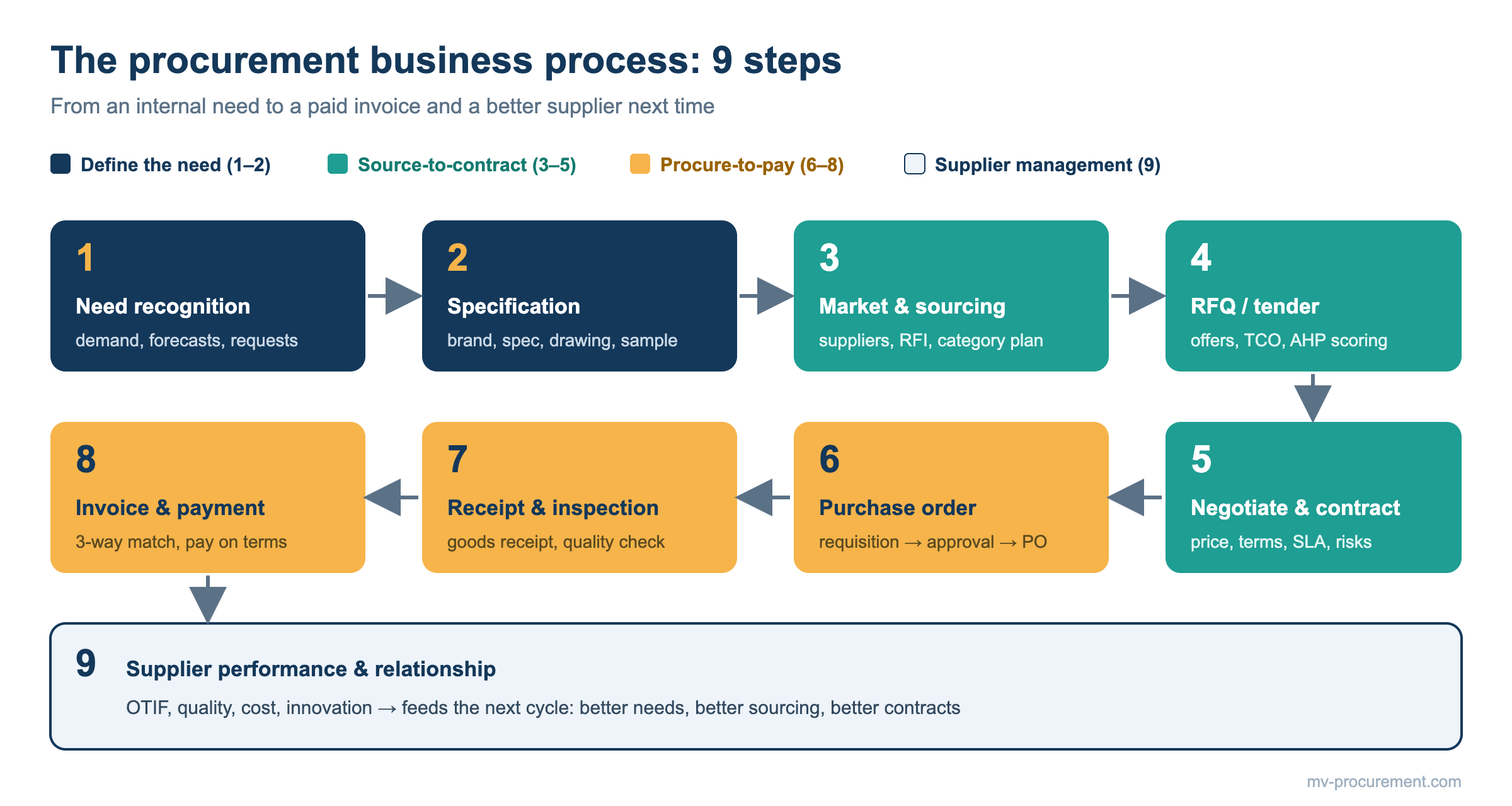
The procurement process at a glance
| # | Step | Owner | Output |
|---|---|---|---|
| 1 | Need recognition | Internal customer + procurement | Requirement, forecast |
| 2 | Specification | Internal customer, engineering, quality | Specification or brief |
| 3 | Market analysis and sourcing | Category manager | Long list of suppliers, sourcing strategy |
| 4 | RFQ / tender and evaluation | Category manager, evaluation team | Short list, scored offers |
| 5 | Negotiation and contract | Category manager, legal | Signed contract or framework agreement |
| 6 | Requisition and purchase order | Requester, buyer | Approved purchase order |
| 7 | Receipt and inspection | Warehouse, quality | Goods receipt note |
| 8 | Invoice and payment | Accounts payable | Matched invoice, payment on terms |
| 9 | Supplier performance and relationship | Category manager | Scorecard, improvement plan |
Steps 3–5 are often called source-to-contract: the strategic part where most of the value is created. Steps 6–8 are procure-to-pay (P2P): the operational part where most of the effort and errors sit. Together with supplier management they form source-to-pay.
The nine steps of the procurement process
Step 1. Need recognition
The process starts long before a requisition. A good procurement team anticipates the needs of internal customers: it reads production and sales plans, sees seasonal peaks and warns colleagues about market changes, for example a price increase in local currency after a devaluation, or a coming shortage of a material. In those cases a forward order placed early is worth more than any negotiation later. One of the quiet goals of this step is to reduce the flow of so-called “urgent requests”.
Key documents: demand forecast, purchase requisition, project brief.
Typical mistake: procurement learns about the need when the requester already has a preferred supplier and a deadline of “yesterday”.
Step 2. Description of the need (specification)
This is where most of the cost is decided. Around 70% of the opportunity to influence the cost of a final product appears at the stages of recognising and describing the need, when the concept and design are still open. A buyer and a supplier involved at this stage contribute far more than in routine ordering. The way you describe the requirement also decides how many suppliers can compete (see the methods below).
Key documents: specification, technical drawing, sample, service level description.
Typical mistake: a specification copied from the incumbent supplier’s catalogue, which quietly locks out everyone else.
Step 3. Market analysis and sourcing strategy
Before asking for prices, understand the market: who can supply, at what capacity, what drives the price (raw-material indices, energy, labour, freight), and how risky the category is. The category’s position on the Kraljic matrix tells you whether to run a competitive tender, secure supply or build a partnership.
Key documents: market analysis, long list, RFI, sourcing strategy.
Typical mistake: going straight to an RFQ with the same three suppliers as last year.
Step 4. RFQ, tender and supplier evaluation
Send a clear request for quotation or proposal with the same specification and the same commercial template to all bidders, so offers are comparable. Compare them on total cost of ownership, not unit price: freight, duties, payment terms, quality and inventory often change the ranking. For non-price criteria a structured method such as AHP keeps the weighting honest.
Key documents: RFQ/RFP, bid comparison, TCO model, supplier scorecard.
Typical mistake: choosing on unit price and discovering the real cost a year later.
Step 5. Negotiation and contract
Prepare the negotiation: your target and walk-away position, the supplier’s likely position, and what you can trade. Then fix it in a contract: price and price-adjustment formula, volumes, delivery and quality terms, payment terms, service levels, penalties, exit clauses and risk allocation. For volatile commodities, decide here whether to hedge.
Key documents: negotiation plan, contract, framework agreement, SLA.
Typical mistake: a great price with no indexation formula, renegotiated under pressure at the first market spike.
Step 6. Requisition and purchase order
Operational buying starts with a requisition that is approved according to a delegation of authority and turned into a purchase order against the contract. Catalogues and framework agreements make this step almost automatic for repeat items, which frees buyers for strategic work.
Key documents: purchase requisition, approval workflow, purchase order.
Typical mistake: orders placed outside contracts (“maverick spend”), which destroy the savings negotiated in step 5.
Step 7. Receipt and inspection
Goods are received against the purchase order: quantity, condition, documents and, where needed, quality inspection. Services are confirmed by the internal customer. Discrepancies are recorded immediately, not discovered at the invoice stage.
Key documents: delivery note, goods receipt note, inspection report.
Typical mistake: accepting deliveries without checking, so defects surface on the production line.
Step 8. Invoice and payment
Accounts payable match the invoice with the purchase order and the goods receipt (a three-way match) and pay on the agreed terms: not earlier, which wastes working capital, and not later, which damages the relationship and sometimes the price.
Key documents: invoice, three-way match, payment run.
Typical mistake: invoices without a PO, paid after long manual chasing.
Step 9. Supplier performance and relationship management
The cycle closes with measurement: on-time-in-full delivery, quality, cost versus market, responsiveness and innovation. The results feed the next round: better specifications, a different sourcing strategy, development plans for key suppliers or an exit plan for weak ones.
Key documents: supplier scorecard, business review, improvement plan.
Typical mistake: a scorecard nobody looks at until there is a crisis.
How to describe a need: six methods
Step 2 deserves a closer look, because the way a requirement is described decides how much competition and value you can get. There are six main methods:
| Method | When it works | Risk |
|---|---|---|
| Brand name | Secret or patented process; know-how that is hard to formalise; very small volumes; strong user preference | High price, dependence on one brand, fewer suppliers |
| Brand “or equivalent” | You want a reference point but stay open to alternatives | Disputes about what counts as equivalent |
| Specification (physical and chemical characteristics, materials and methods, performance or function) | Standard materials, repeat purchases, tenders | Over-specification adds cost; under-specification lets quality slip |
| Technical drawing | Engineered parts and custom components | The drawing must be up to date and owned by you |
| Market grade or samples | Commodities with standard grades; food, textiles, packaging | Samples must be stored and controlled |
| Combination | Most real purchases | Conflicting requirements between parts of the description |
A brand-based description shows trust in the supplier: the assumption is that a manufacturer protects the reputation of its trade mark, so every item with the same brand will match the quality of the original. It is justified when specifications cannot be given precisely, the purchased amount is small, or users strongly prefer a model. The cost is higher prices and a narrower supplier base. A function- or performance-based specification usually opens the market the most.
Procure-to-pay, source-to-pay and source-to-contract: what is the difference?
| Term | Covers | Focus |
|---|---|---|
| Source-to-contract (S2C) | Steps 3–5: market analysis, sourcing, tender, negotiation, contract | Value: price, terms, risk, supplier choice |
| Procure-to-pay (P2P) | Steps 6–8: requisition, purchase order, receipt, invoice, payment | Efficiency and compliance: speed, accuracy, control |
| Source-to-pay (S2P) | The whole cycle, usually including supplier management | End-to-end: value plus execution |
Procurement process KPIs
| KPI | What it shows |
|---|---|
| Spend under management / contract coverage | How much spend goes through negotiated contracts |
| Maverick spend | Purchases outside contracts and approved suppliers |
| Sourcing cycle time | Days from need to signed contract |
| PO cycle time | Hours or days from requisition to purchase order |
| On-time-in-full (OTIF) | Supplier delivery reliability |
| First-time-right invoices | Share of invoices matched without manual work |
| Savings and cost avoidance | Value delivered versus baseline or market index |
| Supplier quality (PPM, defect rate) | Cost of poor quality coming from suppliers |
Example: buying packaging for a restaurant chain
- Need. The menu team plans a new product in six months; packaging demand is forecast at 2 million units a year.
- Specification. Procurement and quality agree a performance-based spec (grease resistance, stacking strength, recycled content) instead of copying the current supplier’s item code.
- Sourcing. The category is a leverage category on the Kraljic matrix: many capable suppliers, meaningful spend. The strategy is a competitive tender.
- Tender. Five suppliers quote; the comparison is on TCO, including freight to two regional warehouses and minimum order quantities.
- Contract. A two-year framework agreement with a price formula linked to a paper index and an annual review.
- PO. Restaurants order from a catalogue; orders are generated from consumption.
- Receipt. Warehouses check quantity and carton condition; quality checks a sample per batch.
- Payment. Three-way match, payment at 60 days as agreed.
- Performance. A quarterly scorecard on OTIF, defects and price versus index feeds the next tender.
Common mistakes in the procurement process
- Procurement joins at step 4 instead of step 1, when most of the cost is already fixed.
- Specifications written around one supplier.
- Unit price as the only selection criterion.
- Contracts without price-adjustment rules or exit clauses.
- Buying outside contracts, which erases negotiated savings.
- No feedback from supplier performance into the next sourcing cycle.
Digitising the procurement process
Each step can be supported by software: e-sourcing and e-auction tools for steps 3–5, catalogues and P2P platforms for steps 6–8 (see electronic catalogs), and supplier management tools for step 9. Technology speeds up a working process; it does not fix a broken one. Map and simplify the process first, then automate.
FAQ
What is the procurement business process? The end-to-end sequence of steps used to acquire goods and services: need recognition, specification, sourcing, tender, contract, purchase order, receipt, payment and supplier management.
How many steps are in the procurement process? Models vary from five to ten steps. The nine-step version above separates strategic sourcing from operational buying, which makes ownership and KPIs clearer.
What is a three-way match? A check that the invoice, the purchase order and the goods receipt agree on item, quantity and price before payment is released.
Who owns the procurement process? Procurement owns the process design and steps 3–6 and 9; internal customers own the need, warehouses and quality own receipt, and finance owns payment. The process works only when these hand-offs are explicit.
1 комментарий к “Procurement Business Process: 9 Steps from Need to Payment”