Эта статья на русском: читать по-русски
A few weeks ago I finished Chris Miller's Chip War. Then, almost immediately, picked up The Thinking Machine.
Reading them back to back does something to your head — especially if you spend your professional life thinking about procurement. Miller's book is nominally geopolitics. But strip away the Cold War narrative and what you have is a 400-page case study in supply chain concentration risk: one geography, one process node, one equipment supplier, and the entire trajectory of technological civilisation hanging on the yield rates at a fab in Taiwan.
The Thinking Machine extends the frame into the AI era. The compute race is real. The demand for GPUs is not a cyclical blip — it's a structural shift in what the world needs to run.
Somewhere between the two books, a question formed that I couldn't shake: the procurement problem described here — volatile demand, constrained spot supply, stochastic yield — I've modelled this before. Just with different SKUs.
For the past several years, building supply chain and procurement functions for a global QSR franchise across 25 countries, our team implemented various mathematical models for commodity price hedging — futures, forwards, and exchange-traded options on wheat, dairy, and packaging materials. The goal was always the same: reduce risk-adjusted cost, not just nominal cost, when supply is uncertain and demand is volatile.
One framework we developed — which I described in a previous article as EFOS (Extended Forward-Option-Spot) — was designed specifically for situations where spot supply has a hard capacity wall and yield uncertainty amplifies procurement cost non-linearly.
I ran that model against GPU procurement parameters. The results were uncomfortably familiar.
The FOS Framework — Translated
Classical commodity procurement distinguishes three instruments:
Forward (F): A commitment 12–18 months ahead at a fixed price. You lock in volume and accept quantity risk.
Option (O): You pay a premium for the right — not the obligation — to purchase at a set price. Flexibility has a cost.
Spot (S): You buy at market price when needed. Maximum flexibility, maximum price risk.
In QSR these instruments apply directly to agricultural commodities. In GPU procurement, the translation is exact:
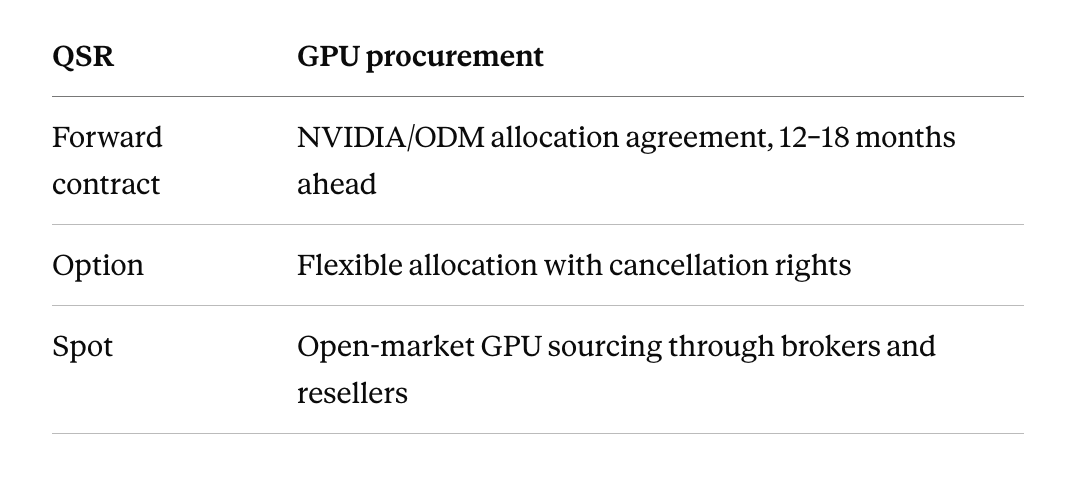
Most data center procurement teams treat GPU buying as primarily a spot problem. That's the same mistake QSR operators made before commodity hedging became standard practice — and it has the same consequence.
The Extension That Changes Everything
Standard FOS models assume spot supply is unlimited at the spot price. Real markets don't work that way.
In QSR, we observed that spot supply for constrained SKUs has a hard capacity wall — C_spot — beyond which prices don't rise linearly. They spike discontinuously. We called this the Supply Cliff.
For GPU procurement, the equivalent constraint is TSMC's CoWoS advanced packaging capacity — the physical bottleneck limiting H100/B200 production regardless of die availability. When demand exceeds C_spot, procurement costs don't increase 10–20%. They jump 40–60% overnight, or supply simply disappears.
We extended the model with two parameters:
β ~ Beta(α, γ) — stochastic yield factor. In QSR: ingredient defect rates. In GPU procurement: TSMC CoWoS yield variability plus GPU binning outcomes (the fraction of produced chips meeting H100 vs. H800 vs. reject spec). β is not fixed — it follows a probability distribution.
C_spot — the hard capacity wall. When demand × (1 + uncertainty) exceeds C_spot, effective cost escalates non-linearly.
The effective spot cost function under EFOS:
P_eff(s, β) = s/(1−β) + c_exp · β/(1−β)
Where s is spot price and c_exp is the expedite premium paid when sourcing beyond C_spot. This is the Lemons Multiplier — yield uncertainty doesn't just reduce effective supply, it amplifies the cost of every marginal unit.
Monte Carlo Results
Parameters (100,000 iterations):
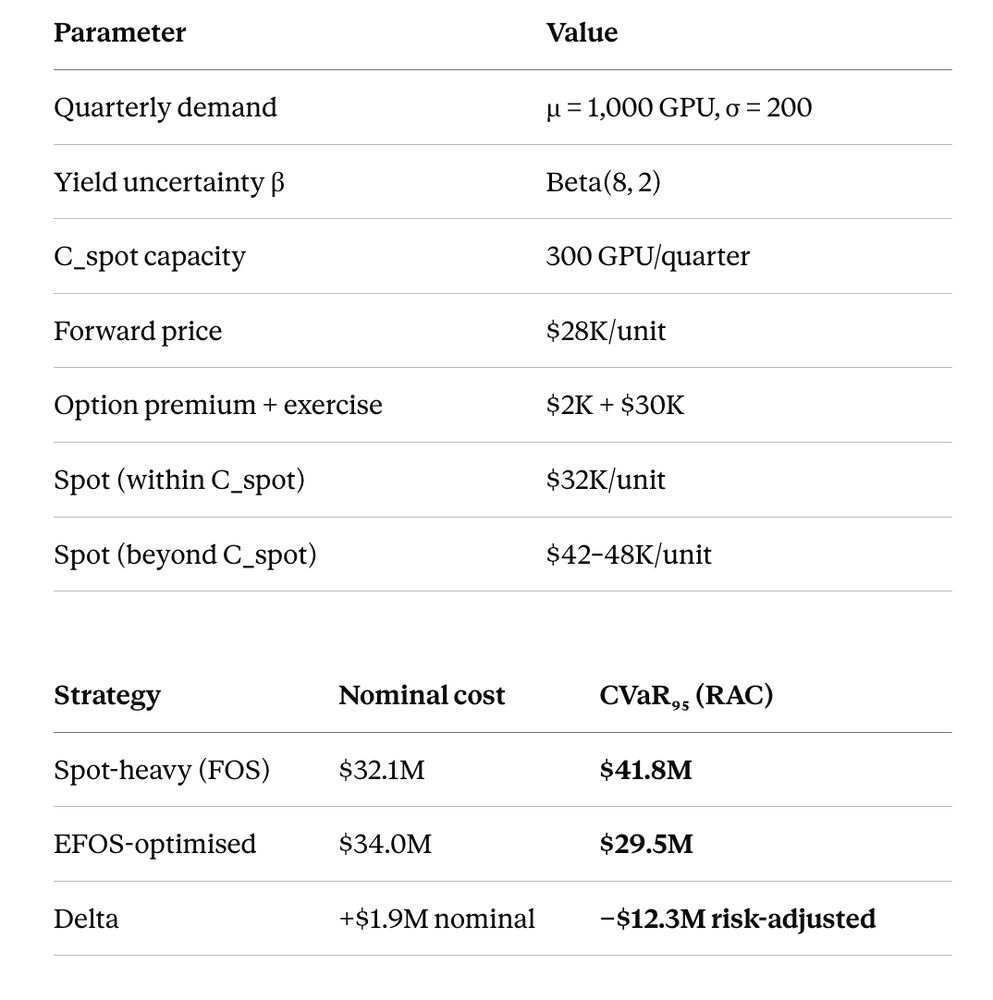
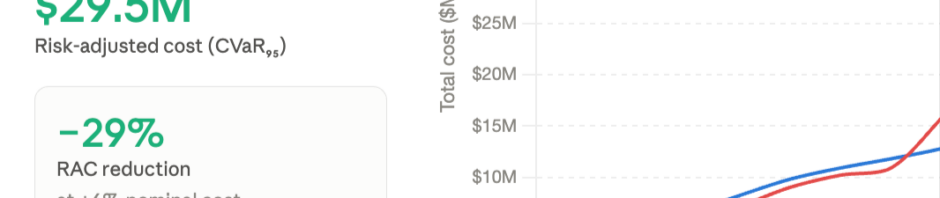
You pay 6% more on paper to remove 29% of your tail risk. Every CFO who has managed commodity exposure understands this trade-off intuitively. GPU procurement teams — many of whom come from software or finance backgrounds — often don't.
The APAC Dimension
The GPU supply chain has a specific geographic structure that amplifies these dynamics for APAC-based operators.
TSMC CoWoS capacity sits in Taiwan. The primary allocation channel runs through NVIDIA's Santa Clara sales organisation. APAC subsidiaries — whether hyperscalers, sovereign AI programs, or enterprise deployers — sit at the back of the queue by default.
This creates a structural C_spot constraint for APAC buyers that doesn't exist for US counterparts: the effective spot supply available to a Singapore or Tokyo-based buyer is smaller, not because global production is insufficient, but because the allocation architecture is centre-heavy.
The implications for procurement strategy:
Forward contracts become disproportionately valuable. The option to secure allocation 12–18 months ahead is worth more when spot access is architecturally constrained.
Local ODM relationships matter more than price. APAC-based ODM relationships — with Quanta, Wistron, or Foxconn — provide a secondary allocation channel that partially circumvents the primary constraint.
Regional volatility correlates with geopolitical events. Taiwan Strait risk isn't a black swan for APAC buyers — it's a correlated tail event that needs to appear explicitly in the β distribution.
Practical Recommendations
For any organisation managing GPU procurement at scale — hyperscaler, sovereign AI fund, or enterprise:
1. Build a tiered procurement portfolio. Allocate forward, option, and spot tranches explicitly. Don't let the portfolio emerge by default.
2. Model β, don't ignore it. Treat yield uncertainty as a distributional input, not a fixed assumption. If you don't have your own data, TSMC quarterly yield disclosures are a starting point.
3. Know your C_spot before you need it. The capacity wall is real, cyclical, and knowable in advance. Map it annually.
4. Price your risk-adjusted cost, not nominal cost. CVaR₉₅ is the number that matters for capital planning. Nominal cost is what you show to finance teams that haven't been through a commodity shock.
5. APAC buyers: add a structural discount to spot availability. Model effective C_spot at 60–70% of global C_spot for allocation-constrained geographies.
Closing Thought
There's a sentence in Chip War that stayed with me: "The entire edifice of modern civilisation runs on silicon produced in a handful of fabs."
The procurement implication of that sentence is exactly what EFOS was built to handle: hard supply ceilings, stochastic yield, and non-linear cost escalation when you push through the wall.
The QSR and semiconductor industries look nothing alike on the surface. But the mathematics of procurement under constraint doesn't care about the SKU.
If you're managing GPU spend at scale — and increasingly, every major organisation is — the question isn't whether you need a portfolio model. It's whether you build one before or after your first supply cliff event.
Originally published on .
