Over the past decade, Asia Pacific has produced some of the most structurally aggressive franchise expansions in the history of food service. And when you look closely at what's driving them, the answer is almost never the menu, the marketing, or the technology. It's the supply chain architecture underneath.
Mixue Ice Cream & Tea operates over 36,000 outlets — more than McDonald's globally — at a price point of $1–2 per drink. Mixue doesn't primarily make money on royalties. It makes money on supply. The company owns its own sugar refinery, farms, packaging factories, and cold chain logistics. Every franchisee is contractually required to source all ingredients from Mixue's supply chain arm. The franchise model, structurally, is a supply chain business.
Luckin Coffee reached 20,000+ stores by inverting the premium coffee model on supply chain economics. Direct procurement from farms in Ethiopia, Brazil, and China's Yunnan province. Centralized roasting at scale. Cold chain distribution with AI-driven demand forecasting integrated directly with app order data. The result: a $2 coffee that is operationally profitable at unit level — something only possible with mastery of every node in the supply chain.
Cotti Coffee, founded in 2022 by former Luckin executives, opened 10,000+ stores in under two years — the fastest QSR expansion in recorded history. The blueprint is deliberately identical: centralized supply chain, tech-enabled operations, aggressive franchise terms. The insight they proved: once the supply chain infrastructure exists, scaling outlet count is an execution problem, not a structural one.
Jollibee operates multi-brand commissaries — single production facilities simultaneously supplying Jollibee, Chowking, Mang Inasal, and Greenwich. One commissary, multiple brands, quality controlled at the source.
Haidilao went furthest: their supply chain arm Shuhai handles procurement, processing, cold chain, and food safety monitoring for 1,600+ hotpot outlets across Asia. Product consistency from Beijing to Singapore is a brand promise only possible when you own the chain.
The pattern is not coincidental. In markets where competitive intensity is extreme and price sensitivity is high, supply chain efficiency is the primary lever simultaneously improving margin, quality, and scale speed.
No single right answer — and why that's the point
The APAC examples above are all high-integration models. But that doesn't make vertical integration universally correct. Supply chain design in QSR sits on a continuous spectrum:
Full 3PL outsourcing — asset-light, variable cost, no capital tied up. You contract a logistics operator for warehousing, transportation, and last-mile delivery. Attractive when your outlet density is low and the 3PL market in the region is mature and competitive.
Hybrid model — you own the production and primary distribution hubs, outsource last-mile. Higher fixed costs, but direct control over quality and lead time at the most critical nodes of the network.
Own logistics — full vertical integration. Maximum capex. Justified only when network density makes the economics of owned infrastructure unambiguously superior.
At Dodo Brands, we operate across 25 countries and three brands, and we deliberately use different supply chain designs depending on the market. The choice of model is driven by two variables above all others: the maturity of the local logistics infrastructure and the scale of the business in that market.
In markets where the 3PL ecosystem is well-developed — competitive operators, reliable cold chain, consistent service levels — outsourcing is often the rational starting point. The infrastructure exists, the pricing is competitive, and building own capacity before the network justifies it destroys capital. In markets where the 3PL market is thin, unreliable, or structurally misaligned with the demands of a food franchise, you face a different calculation: sometimes own infrastructure isn't a strategic choice, it's an operational necessity.
Business scale compounds this. A cluster of 30 outlets dispersed across a large geography behaves completely differently from a cluster of 200 outlets concentrated in a dense urban corridor — even in the same country. The first is almost always better served by a third party. The second may have already crossed the inflection point without anyone having run the numbers.
The result is that within a single company, you can rationally have a full 3PL model in one region, a hybrid in another, and be building toward greater ownership in a third — simultaneously, and without contradiction. The model follows the market, not the org chart.
This tension exists far beyond QSR. Apple outsources manufacturing to Foxconn and TSMC, retaining design and software — maximizing capital efficiency and geographic flexibility. Samsung is vertically integrated: own chip fabs, own display factories, own logistics — maximizing quality control and proprietary advantage across hardware layers. Both are among the most valuable companies in the world. Both are rational given what they are optimizing for. Neither model is inherently superior.
The strategic question is never "should we outsource or own?" It is: "what does our network geometry currently support — and what will it support in three years?"
The math: when does the model switch?
This is where rigorous analysis replaces opinion. The optimal number and location of distribution hubs in a QSR network can be formalized as the p-median facility location problem:
min Σᵢ Σⱼ wᵢ · cᵢⱼ · xᵢⱼ
Subject to: Σⱼ yⱼ = p | Σⱼ xᵢⱼ = 1 ∀i | xᵢⱼ ≤ yⱼ | yⱼ, xᵢⱼ ∈ {0,1}
Where wᵢ is delivery volume at outlet i, cᵢⱼ is the unit cost of servicing outlet i from hub j, and yⱼ indicates whether hub j is open. The model finds the optimal p hub locations that minimize total weighted delivery cost across the network. But it answers the location question, not the ownership question.
For the ownership question, you need the economic threshold condition. A company-owned hub is financially justified when:
F(hub) + c_own · N < c_3PL · N
The key is understanding what c_3PL actually contains. It is not just a delivery rate. A fully-loaded 3PL rate bundles four elements: transportation, warehousing and storage, order management and administration, and the logistics operator's margin — typically 18–25% on top of the underlying costs. This bundling makes 3PL attractive at low scale (you pay only for what you use, fixed overhead is shared across the operator's entire client base) and expensive at high scale (you permanently fund the operator's margin, compounding as your volume grows).
c_own, by contrast, covers transportation and own warehousing only. No external margin. No administration markup. The trade-off is the fixed cost of hub infrastructure — which the 3PL was implicitly spreading across its portfolio.
Rearranging gives the breakeven outlet density n*:
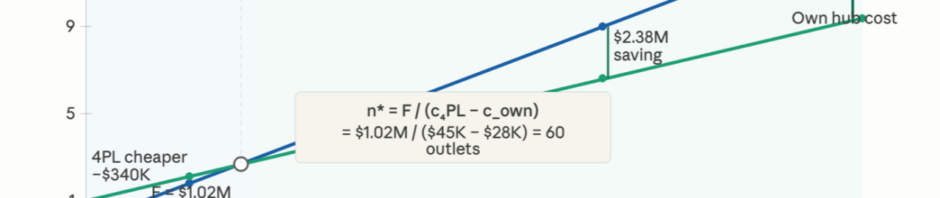
n* = F(hub) / (c_3PL − c_own)
Let's imagine a chain where this plays out
A QSR operator has grown steadily in a regional cluster. Early on, the decision to outsource to a 3PL was straightforward — no capital, no fixed overhead, just a service contract that scaled with the business. But five years later, with the network having grown substantially, the CFO is asking whether that same contract still makes financial sense.
The cost structure looks like this:
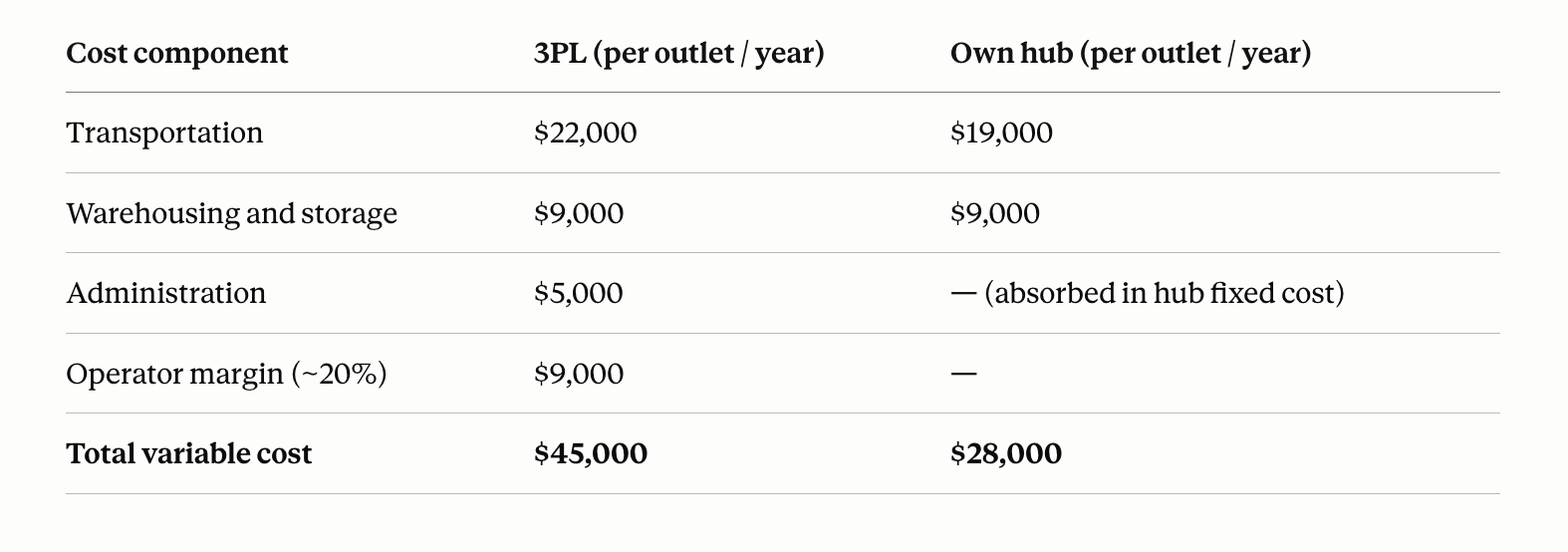
Annual fixed cost of own hub (warehouse lease, operations staff, equipment): $1,020,000
Applying the formula:
n* = $1,020,000 / ($45,000 − $28,000) = $1,020,000 / $17,000 ≈ 60 outlets
Here is what happens as the network grows through that threshold:
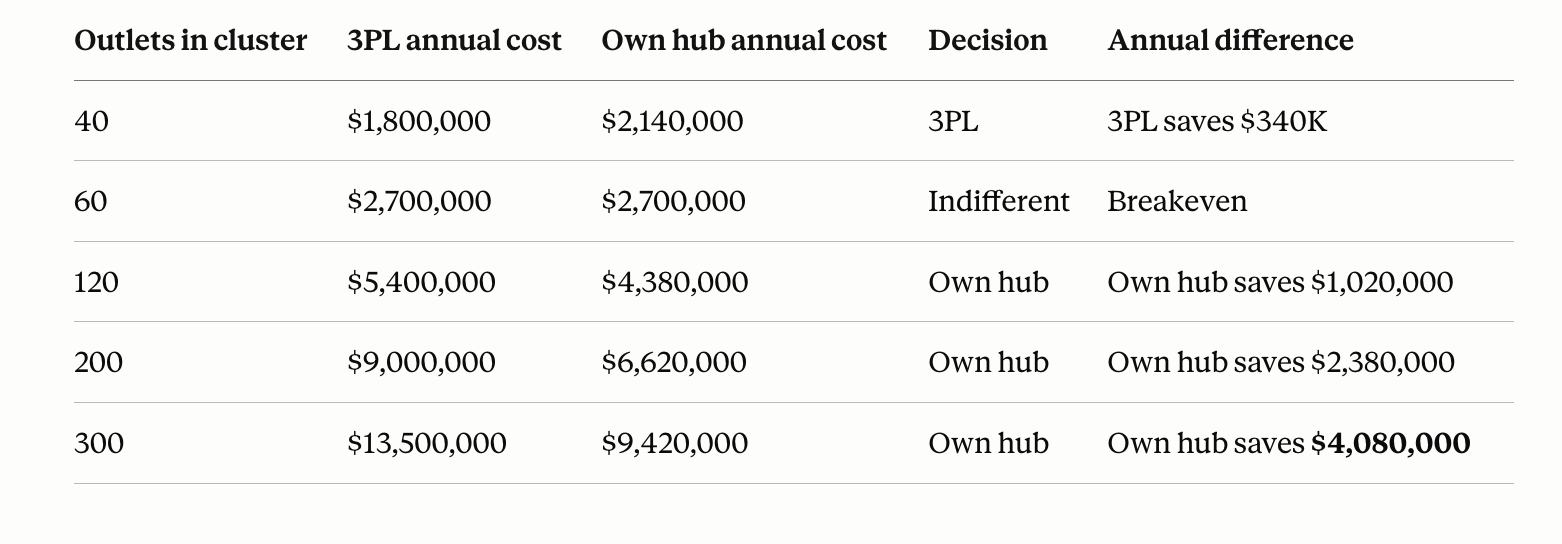
The operator's margin — invisible in a single invoice, unremarkable in a quarterly budget — compounds silently. At 300 outlets, this chain is paying the equivalent of four additional regional hubs every year simply by remaining on 3PL terms past the inflection point.
Note that n* is not a fixed number. It shifts as hub fixed costs evolve (real estate markets, labour costs), as 3PL competitive dynamics change (new entrants, leverage in renegotiations), and as your own operational efficiency improves with scale. A model that was correct at 100 outlets can be wrong at 400 — and correct again, differently configured, at 800.
The practical implication
The APAC chains that built supply chain as a competitive moat did not do it because vertical integration is philosophically superior. They did it because their network geometry crossed the threshold where own infrastructure became the mathematically correct answer — and they moved decisively when it did.
Make-or-buy in QSR logistics is not a one-time strategic decision made at founding and inherited forever after. It is a continuous optimization problem with a moving solution. The model that was right when you signed your first 3PL contract may be quietly costing you millions by the time you have the scale to notice.
Run the analysis annually. Know your n* for every regional cluster. And when the numbers say the model should change — change it.
What does your current network density actually support?
Originally published on .
